
What humidity should a house be in Ireland? There is no single legal indoor target for every room and season. As a practical guide, keeping indoor relative humidity below 60% is generally preferable, while repeated readings around 70% or above increase concern for condensation and mould. Always interpret humidity together with room temperature, ventilation and cold surfaces.
What this usually means
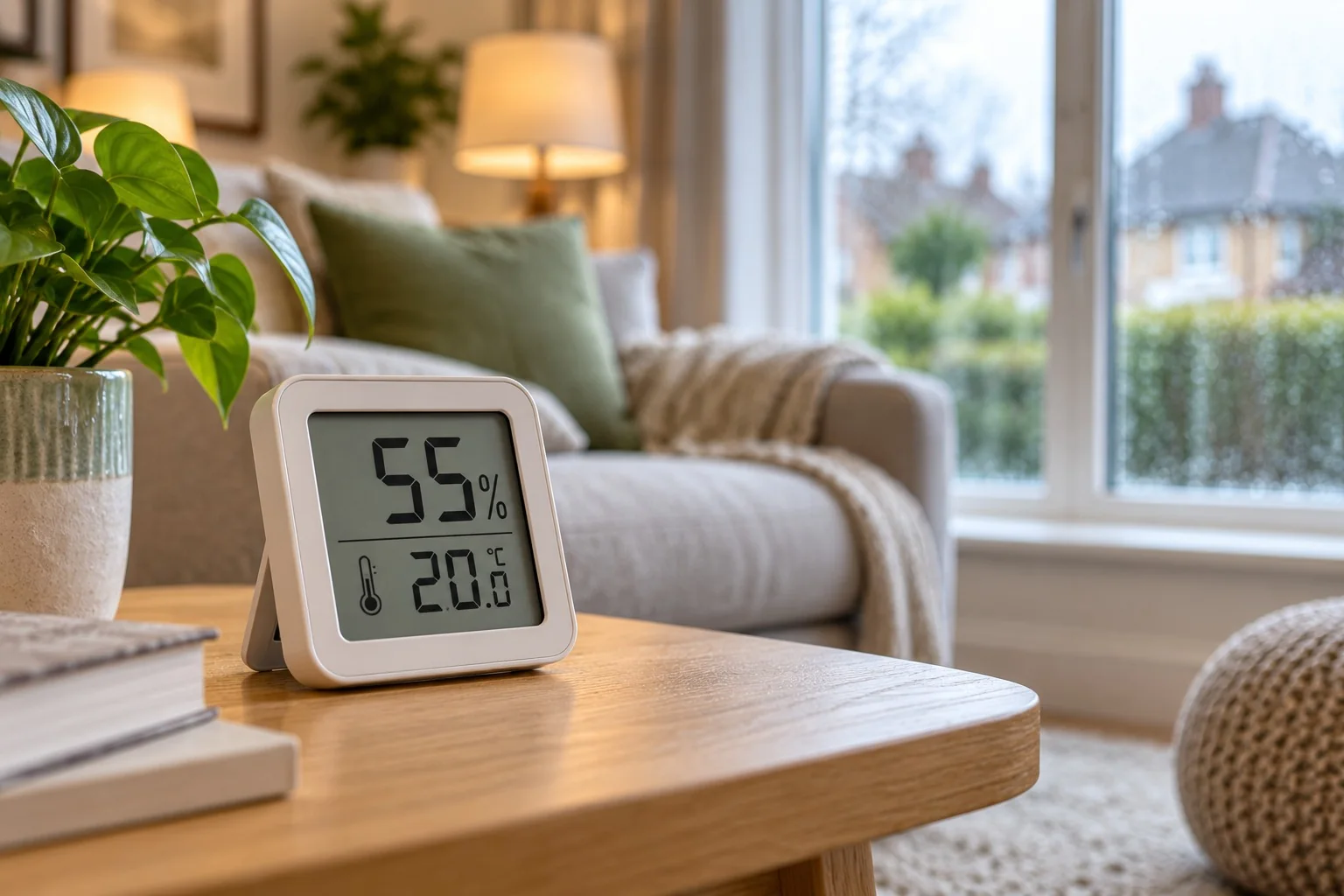
A hygrometer helps most when you use it consistently. Place it away from a radiator, window or direct shower steam and compare readings in the morning, evening and after moisture-producing activities.
What Is a Normal Humidity Level in a House in Ireland?
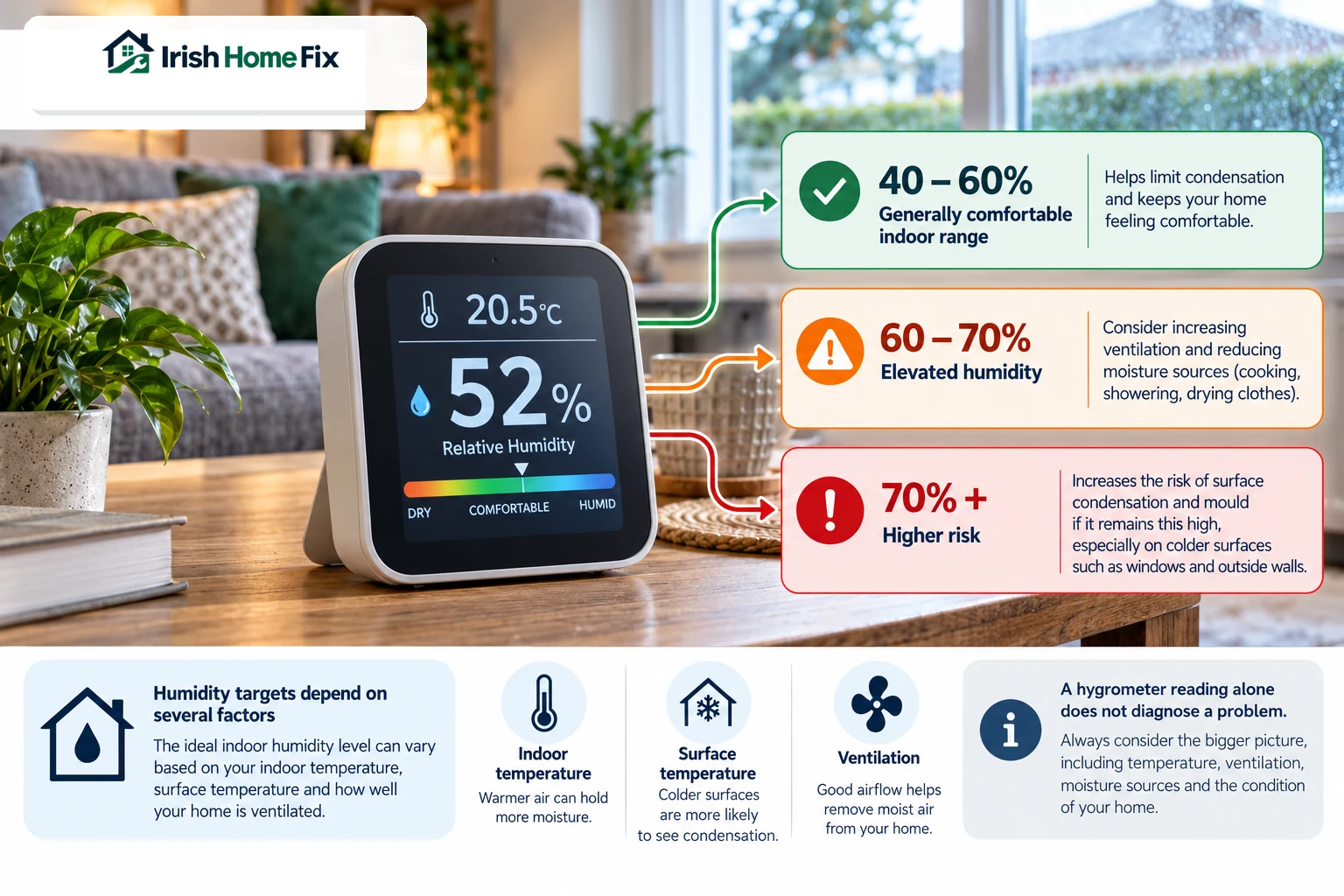
There is no single humidity percentage that is perfect for every Irish home, room and season. As a practical moisture-control reference, indoor relative humidity is generally best kept below 60%, with 30–50% often used as an ideal range where conditions allow.
The number matters most as part of a pattern. A reading of 60% for a short period after cooking or showering does not automatically mean there is a problem. What matters more is whether humidity stays high for long periods, condensation keeps returning, mould develops or rooms remain slow to dry.
Irish retrofit guidance is particularly useful at the higher end of the scale. SEAI guidance identifies relative humidity above 70% as a condition where the risk of surface condensation and potential mould growth increases.
How to Read Your Humidity Level
- Around 30–50% RH: a commonly used indoor reference range, although actual readings vary with season, temperature and the home.
- Around 50–60% RH: not automatically a fault. Watch whether the reading falls again and whether condensation or mould is appearing.
- Repeated readings near or above 70% RH: investigate moisture production, extraction, background ventilation and cold surfaces rather than treating the number alone.
Relative humidity also changes with temperature. The same amount of water vapour can give a higher RH reading in a colder room and a lower reading after that room warms. Compare readings taken under similar conditions and use them alongside what you can actually see in the home.
Likely causes
- Normal household moisture accumulating in a poorly ventilated room.
- Cold room temperatures increasing relative humidity.
- Poor extraction from bathrooms or kitchens.
- Indoor clothes drying.
- Water leaks or damp materials.
Safe checks to make first
- Track relative humidity for at least several days, not just one moment.
- Compare rooms to identify whether the problem is local or whole-house.
- Note whether humidity falls after extraction or window opening.
- Check for condensation on windows and cold corners when readings are highest.
- Use temperature and humidity together when interpreting the pattern.
What to do today
- Place a hygrometer away from a radiator, direct sun, an open window or the immediate plume from a shower or kettle.
- Record morning and evening readings for several days together with room temperature.
- If readings are repeatedly high, check moisture sources, extraction and background ventilation before buying equipment.
What not to do
- Do not place the meter on a cold windowsill and assume it represents the whole room.
- Do not use one reading to diagnose a leak or structural damp.
- Do not deliberately overheat a room solely to make the percentage number fall.
When to get someone qualified involved
- Readings remain very high for long periods and mould or condensation is recurring.
- The home has recently been made more airtight without a ventilation assessment.
- Humidity is concentrated near a suspected leak or damp area.
Irish-home context
SEAI's S.R.54 retrofit guidance notes a risk of surface condensation and potential mould growth when relative humidity is above 70%. The exact risk also depends on surface temperature and thermal bridges, so humidity should be interpreted alongside the building condition.
Frequently asked questions
Is 60% humidity too high?
A brief reading around 60% may occur, but sustained humidity at or above that level increases concern for condensation and mould. The US EPA advises keeping indoor RH below 60% and ideally 30–50% where practical.
Why does my humidity reading fall when I turn on the heat?
Relative humidity depends on temperature. Warmer air can hold more moisture, so the percentage can fall even though no water vapour has actually left the room.
Do I need a hygrometer in every room?
No. One or two meters can be moved between problem rooms to compare patterns. Consistent readings over time are more useful than buying many sensors immediately.
Guidance and references
- SEAI — S.R.54 retrofit guidance (surface condensation and humidity)
- SEAI — Ventilation systems
- US EPA — A brief guide to mould, moisture and your home
Irish Home Fix uses these references for general context. This guide is not a substitute for a site-specific building, electrical, plumbing or medical assessment.