
Morning condensation on bedroom windows is often caused by moisture building up overnight from breathing in a closed room, then condensing on cold glass. A small amount that clears quickly can be seasonal; repeated heavy water, mould or damp smells deserve a closer look.

What this usually means
The useful clue is timing. If the glass is dry during the day but wet first thing in the morning, overnight humidity and cold window temperatures are likely involved. If the wall, ceiling or window reveal is also damp, or moisture remains all day, do not assume it is only ordinary condensation.
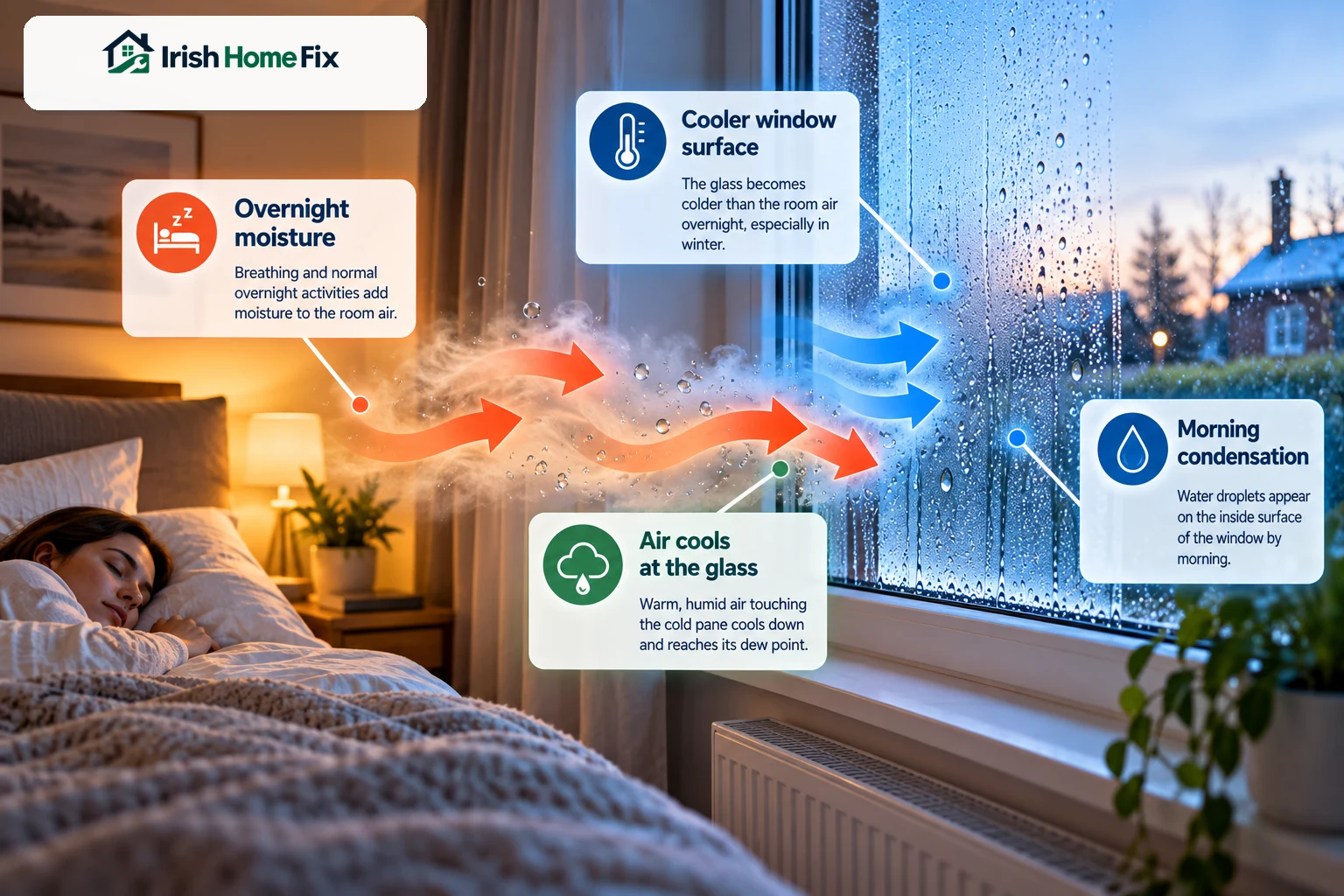
Why bedrooms often show the problem first
A closed bedroom can accumulate moisture overnight simply because people are breathing in it for many hours while the outdoor temperature falls. If the window surface cools below the dew-point temperature, that moisture becomes visible as droplets by morning.
Morning-only moisture that clears as the room warms is a different pattern from a wall that stays damp all day. Check the whole room rather than only the pane: corners, the back of wardrobes, the window reveal and the area behind heavy curtains are useful places to look for repeated surface moisture.
Likely causes
- Overnight moisture from occupants in a closed bedroom.
- Closed or blocked background vents and limited air exchange.
- Cold glazing, reveals or thermal bridges around the window.
- Very low room temperatures overnight.
- Large wardrobes, curtains or blinds reducing air movement near cold external surfaces.
Safe checks to make first
- Check whether any trickle vent or wall vent in the room is open and unobstructed.
- Measure humidity before bed and on waking for several mornings.
- Compare the problem on nights with the bedroom door open versus closed, without compromising fire safety or security.
- Keep curtains or blinds from sealing the window area completely and allow some air movement.
- Look behind furniture on external walls for hidden mould or damp patches.
What to do today
- Make sure the bedroom background vent or trickle vent is open, clean and not hidden by curtains.
- Avoid drying laundry in the bedroom and check whether an ensuite bathroom is adding moisture without effective extraction.
- Use a hygrometer for a week and note readings before bed and on waking rather than relying on one isolated reading.
What not to do
- Do not prop open a fire door simply to increase airflow; fire-safety features should keep working as designed.
- Do not push large wardrobes tightly against a cold external wall if mould is already forming behind them.
- Do not treat a persistent musty smell as a cosmetic issue if no visible mould is present.
When to get someone qualified involved
- Mould repeatedly returns around the window or on an external wall.
- The room has no effective background ventilation.
- Moisture is present in the wall fabric rather than only on the glass.
- There is a strong musty smell or visible damage to plaster, timber or finishes.
Irish-home context
SEAI guidance explains that colder outdoor conditions increase the chance of warm indoor moisture condensing on cooler building surfaces. Bedrooms can be especially affected because moisture accumulates overnight while windows and external walls are cool.
Frequently asked questions
Does breathing really create enough moisture to wet a window?
Over a full night, occupants add moisture to a closed bedroom. Whether it becomes visible depends on ventilation, room temperature, occupancy and how cold the glass and reveals become.
Should I leave a bedroom window open all night?
Not necessarily. The goal is reliable background ventilation appropriate to the home, not uncontrolled heat loss or a security risk. Use the ventilation provisions intended for the room and purge-ventilate when appropriate.
Why is the bedroom worse than the living room?
Bedrooms can be cooler overnight, occupied for many continuous hours and less ventilated, while living rooms may be warmer and have more air movement during the day.
Guidance and references
Irish Home Fix uses these references for general context. This guide is not a substitute for a site-specific building, electrical, plumbing or medical assessment.